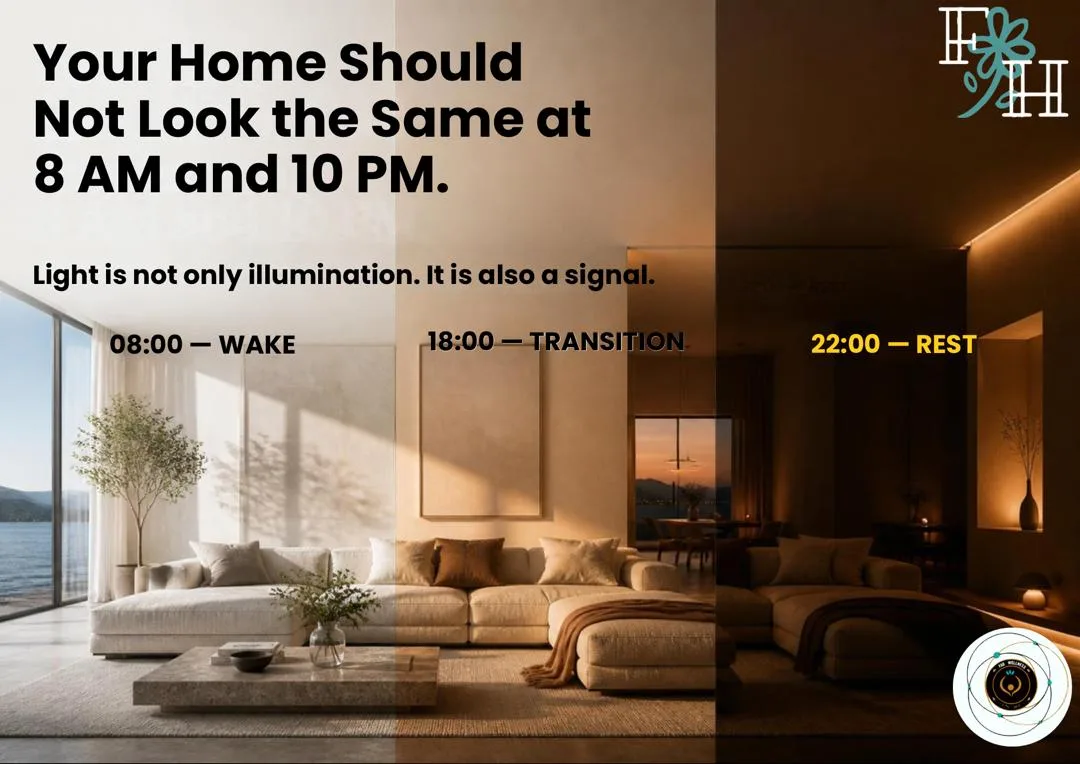
When we talk about interior design, lighting is often discussed in terms of aesthetics.
Is the room bright enough?
Does the pendant light complement the furniture?
Does the lighting create the right atmosphere?
Are there enough decorative fixtures?
These questions matter.
But lighting does something much more fundamental than making a room look beautiful.
Light is one of the environmental signals that helps regulate our body’s internal clock — our circadian rhythm.
This means that the way we use light throughout the day can influence how our bodies transition between alertness and rest.
And this raises an important question:
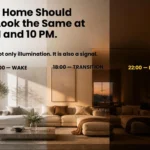
Why do we design our homes as though 8 a.m. and 10 p.m. require exactly the same kind of light?
They don’t.
Our environment changes throughout the day.
Our lighting should be able to change with it.
Your Body Has a Clock
The human body operates according to an approximately 24-hour cycle known as the circadian rhythm.
This internal timing system helps coordinate many biological processes, including the sleep-wake cycle.
Light is one of the strongest environmental cues influencing this system.
During the day, exposure to light — particularly bright light — helps signal to the body that it is daytime.
As evening approaches and the environment becomes naturally darker, the body begins preparing for night.
This transition is important.
Our ancestors experienced a natural progression from bright daylight to darkness.
Modern life, however, has changed the environment dramatically.
We can now illuminate our homes at any intensity, at any time, regardless of whether it is day or night.
We can sit under bright ceiling lights at midnight.
We can work from laptops in dark bedrooms.
We can walk into a bathroom and activate a bright overhead light in the middle of the night.
We can keep televisions, phones and other illuminated devices around us long after the sun has gone down.
The technology is convenient.
But our biology has not changed at the same speed.
The Problem With Treating Light as Simply “On” or “Off”
Most residential lighting is designed around a relatively simple question:
Do we have enough light to see?
Wellness lighting asks a different question:
Is this the right kind of light for this time of day and activity?
That distinction is important.
The body does not experience all light in exactly the same way.
The effect of light depends on factors including:
- Timing
- Intensity
- Duration
- Spectral characteristics
- Direction
- Position within the visual field
- The amount of light reaching the eyes
- The activity taking place at the time
This means that a lighting strategy for a kitchen at 8 a.m. does not necessarily need to be the same as one for a bedroom at 10 p.m.
Morning Light: Tell the Body It’s Time to Wake Up
Morning is a transition.
We move from sleep into alertness and activity.
A wellness-oriented lighting strategy can therefore use brighter, clearer light during the morning and daytime to support the body’s perception that it is daytime.
Natural daylight is particularly valuable.
Where possible, homes can be designed to introduce morning daylight through windows, skylights and appropriate spatial orientation.
Artificial lighting can then supplement natural light when necessary.
The objective isn’t simply to make the room brighter.
It is to create an environment that feels appropriately awake, clear and active for the time of day.
Imagine waking up and gradually moving into a naturally brighter environment rather than immediately switching on a harsh overhead light.
The difference can be subtle.
But the experience of the space changes.
Evening Light: Help the Environment Transition
Now consider 9 or 10 p.m.
You may be preparing for bed.
You may be reading.
You may be having a quiet conversation.
You may be relaxing after a long day.
But if the room is still illuminated with the same bright, high-intensity lighting used during the morning, the environment is sending a very different visual signal from the one naturally associated with nighttime.
This is where layered lighting becomes valuable.
Instead of relying on one powerful ceiling fixture, a home can use multiple sources of light at different levels.
For example:
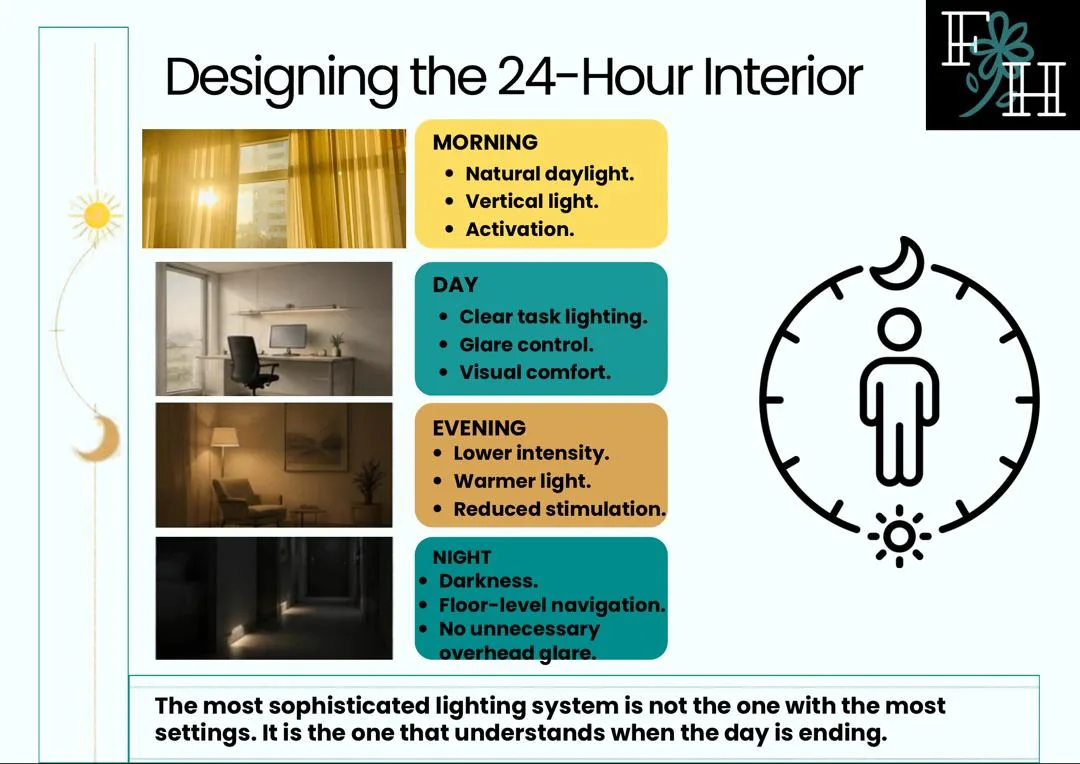
Morning: Brighter ambient light and stronger access to daylight.
Afternoon: Balanced general lighting appropriate for activity.
Evening: Warmer, softer and lower-intensity lighting.
Late night: Minimal, low-level lighting focused only where it is needed.
The home begins to change with the day.
Why Does Bright Light at Night Matter?
This is where circadian-aware lighting becomes particularly interesting.
Light reaching the eyes in the evening can influence the body’s biological timing system.
Bright light at night can suppress melatonin production and, depending on its timing and intensity, interfere with the body’s preparation for sleep.
This does not mean that every exposure to artificial light at night will automatically cause poor sleep.
Human responses vary, and the context matters.
But it does mean that the lighting environment is worth considering when designing spaces intended for rest.
The goal is not to live in darkness after sunset.
The goal is to create an environment that gradually becomes more compatible with nighttime.
The 10 p.m. Bathroom Problem
Consider something very ordinary.
You wake up during the night and need to use the bathroom.
You walk into the bathroom and switch on the main light.
Suddenly, the environment goes from dark to extremely bright.
Your eyes are exposed to a strong overhead light.
You return to bed.
The experience may be very different from simply using a small, low-level light positioned near the floor.
This is why wellness lighting considers where light is placed, not only how much light exists.
For nighttime circulation, low-level pathway lighting can provide enough illumination to move safely without creating the same visual impact as a bright ceiling fixture.
The technology can be almost invisible.
The experience is what matters.
Circadian Lighting Is Not About Making Everything Orange
There is sometimes a misconception that wellness lighting simply means using warm, yellow light at night.
It is more sophisticated than that.
Circadian-aware lighting considers the timing, intensity, spectrum and distribution of light.
A successful strategy may involve changing several variables throughout the day.
For example, lighting systems can be designed to:
- Provide stronger illumination during active daytime periods
- Reduce intensity as evening progresses
- Use appropriate colour characteristics for different times
- Reduce direct exposure to bright light late at night
- Provide low-level pathway lighting
- Create separate lighting scenes for waking, working, dining, relaxing and sleeping
- Give occupants greater control over their environment
The technology should serve the person.
It should not become the centre of attention.
What Happens When We Ignore the Rhythm?
Modern life makes it easy to create environments that are constantly bright.
There may be no meaningful transition between day and night.
We work under bright lights.
We watch television under bright lights.
We use phones and computers late into the evening.
We walk into bathrooms under bright ceiling lights.
We sleep in environments that may not be completely dark.
The consequences are not identical for everyone, and lighting is only one factor affecting sleep and wellbeing.
However, exposure to inappropriate light at the wrong time can interfere with circadian timing and sleep processes.
This is why the design of the nighttime environment matters.
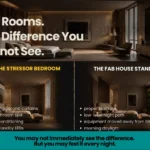
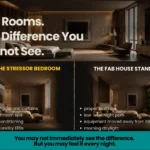
A bedroom should not only be beautiful.
It should help create the conditions for rest.
What Happens When We Design With the Rhythm?
Now imagine the opposite.
Morning begins with daylight.
The kitchen and living areas become brighter as the day begins.
Work areas have appropriate task lighting.
The home remains well illuminated during active periods.
As evening arrives, the lighting gradually becomes softer.
The living room transitions into a more relaxed environment.
Bedrooms remain relatively dark.
Bathrooms have low-level nighttime lighting.
Corridors are illuminated sufficiently for safe movement without becoming excessively bright.
The environment begins to support the natural progression of the day.
Nothing necessarily looks futuristic.
Nothing has to feel clinical.
It simply feels right for the moment.
That is the opportunity of wellness lighting.
Lighting Should Be Designed Around Activities, Not Just Rooms
Traditional lighting design often asks:
“What light does this room need?”
Wellness design can ask:
“What does the person need to do here, and at what time?”
A bedroom may need:
- Bright enough lighting for dressing
- Focused lighting for reading
- Soft ambient lighting for relaxation
- Very low-level lighting for nighttime movement
- Excellent darkness during sleep
One room may therefore require several lighting conditions.
The same principle applies throughout a home.
A kitchen used for preparing breakfast at 7 a.m. is not necessarily the same environment as a kitchen used for a late-night snack.
A home office used at midday is different from a workspace used at 10 p.m.
A bathroom used in the morning is different from a bathroom visited briefly during the night.
The activity changes. The time changes. The lighting can change too.
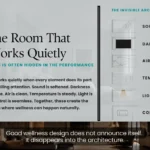
Designing Light That Works Quietly
The most successful wellness lighting may not be the lighting people talk about.
People may not say:
“This house has an excellent circadian lighting strategy.”
They may simply say:
“I sleep really well here.”
“This room feels relaxing at night.”
“The mornings feel so bright and fresh.”
“I don’t need to turn on all the lights when I wake up during the night.”
That is the point.
The technology, controls and design decisions should support the experience without demanding attention.
What Can Wellness Lighting Look Like in a Home?
A wellness-focused home might incorporate:
1. Layered Lighting
Instead of relying on a single central ceiling fixture, combine ambient, task, accent and low-level lighting.
2. Dimming
Allow light intensity to change according to time, activity and personal preference.
3. Lighting Scenes
Create different settings for waking, working, dining, relaxing, reading and preparing for sleep.
4. Low-Level Night Lighting
Use discreet pathway lighting in bedrooms, hallways and bathrooms for nighttime movement.
5. Daylight Integration
Maximise useful natural daylight while managing glare and excessive heat.
6. Appropriate Light Distribution
Think about where the light reaches — particularly the amount and intensity of light entering the visual field.
7. Automated Transitions
Smart systems can gradually change lighting conditions throughout the day rather than requiring the occupant to manually adjust every fixture.
8. Personal Control
Technology should provide options rather than remove choice. People have different schedules, needs and sensitivities.
Wellness Lighting Is About More Than Sleep
Although sleep is one of the most obvious areas where circadian-aware lighting matters, the concept extends further.
Our environment affects how we experience:
- Alertness
- Relaxation
- Focus
- Comfort
- Orientation
- Safety
- Daily routines
- Transitions between activities
A well-designed lighting environment can therefore become part of a broader wellness strategy.
It can help a home feel energetic when activity is required and calm when restoration is the priority.
The Bigger Question: What Is Your Home Telling Your Body?
Every environment sends signals.
Temperature sends a signal.
Sound sends a signal.
Smell sends a signal.
Materials send a signal.
And light sends a particularly powerful signal because it interacts directly with the body’s biological timing system.
So when we design a home, perhaps we should ask more than:
“Does this light look beautiful?”
We should also ask:
“What is this light communicating to the body?”
Is it telling the body:
Wake up?
Focus?
Relax?
Prepare for sleep?
Or is it simply saying:
It’s always daytime here.
Designing With the Human Rhythm
At Fab House, we believe wellness design should bring together aesthetic beauty, functionality and human wellbeing.
Lighting is one part of that approach.
We look beyond the appearance of a space to consider how environmental factors can support the people who use it.
For homes, hospitality spaces, workplaces, wellness centres, healthcare environments and other facilities, this means asking how light, sound, temperature, air, materials, movement and spatial planning work together.
Because a wellness space is not simply a space that contains wellness products.
It is a space that has been intentionally designed around the human experience.
And sometimes, the most important wellness feature is the one you barely notice.
The light gradually becomes softer.
The room becomes calmer.
The body begins to understand that it is time to rest.
That is when lighting stops being just decoration.
It becomes part of the wellness experience.
Let’s Talk About Wellness Lighting
Are you an architect, interior designer, property developer, hotelier, homeowner or wellness professional interested in creating spaces that support human wellbeing?
Fab House can work with design and development teams to explore how wellness principles can be integrated into the planning, design and operation of spaces.
Because the best wellness design doesn’t simply ask how a space looks.
It asks how the space makes people live, function, recover and feel.